Find IPv4 Subnets Faster with GEO, PI, PA, and Legacy Type Filters
January 13, 2026
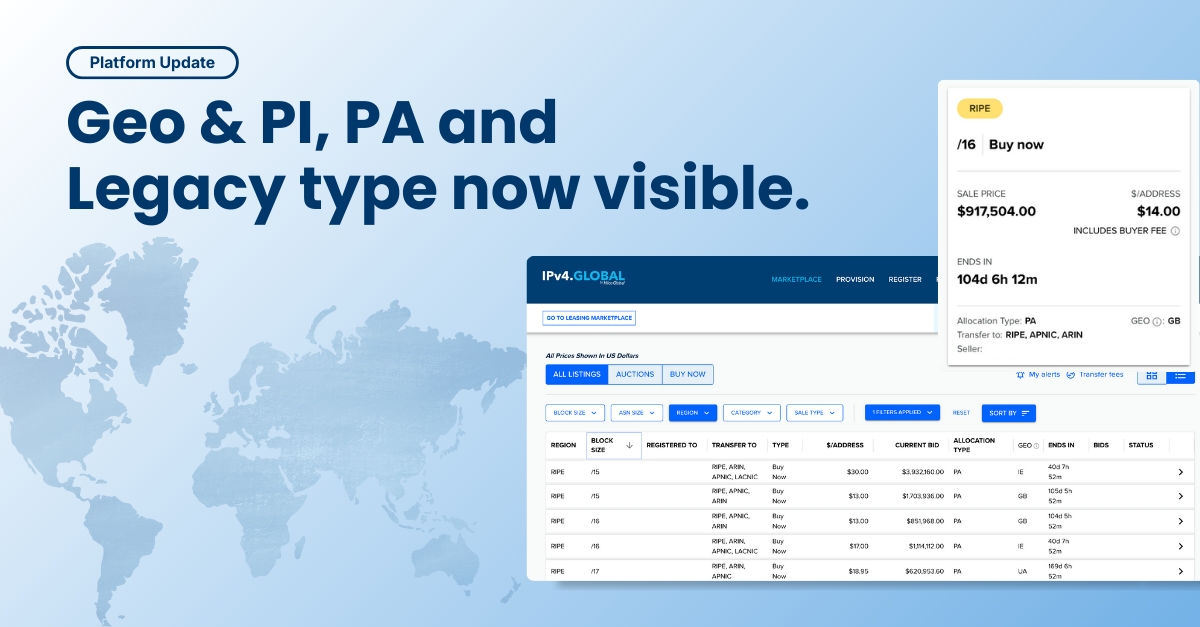
Not all subnets are the same when it comes to buying for your business, and sourcing the right fit goes beyond just price and size. Sifting through hundreds and thousands of options to find what you need can be frustrating, time-consuming, and not the best use of your time.
We focused on one of the most critical priorities our clients hold and rolled out two new filters: Geolocation filtering and Allocation Type filtering. While simple, they solve some of the biggest challenges buyers face when transacting on our marketplace every day. Here’s why it matters and how it will make life easier (and cheaper) for our clients.
What we did and why it matters
Geolocation
Depending on their intended use of the addresses, some organizations may have a need for specified geolocation of the IP addresses.
This data is obtained from a geolocation database at the time the subnets are listed. Geolocation matters because it is often used to enforce location-based security and access controls, support fraud detection and compliance with regional policies, and tailor user experiences such as content localization, regional pricing, or performance optimization based on user location. This filter gives buyers a way to find IP space that fits their requirements faster and easier than ever before.
Note that buyers can update the geolocation on purchased IP addresses after the purchase is complete, so buyers shouldn’t limit their scope to the addresses that are a perfect fit. In any event, purchasing addresses that do match your geolocation requirements can save the time and effort needed to make those changes and get the purchased addresses into production sooner.
A common point of confusion is the distinction between geolocation and governance of IP addresses. While both are important considerations for buyers, they address different risks and requirements.
- Geolocation refers to where an IP address is believed to be located or used, based on geolocation databases.
- Potential usage friction: network access restrictions, content blocking, email deliverability issues, and localization mismatches.
- Potential usage friction: network access restrictions, content blocking, email deliverability issues, and localization mismatches.
- Governance refers to the administrative authority responsible for the IP address, as determined by the relevant Regional Internet Registry (RIR), such as APNIC, RIPE, ARIN, LACNIC, and AFRINIC.
- Potential usage friction: compliance and policy requirements, sanction-related restrictions, and RIR policies tied to IP registration, transfer, and ownership.
Buyers on our platform can filter by both geolocation and governance to identify IP space that best aligns with their technical, operational, and compliance requirements.
Allocation Type
Allocation type reflects how IP space was issued and governed, which influences routing characteristics, portability, and policy requirements.
PI Space
- Issued to end-user organizations directly by the RIR
- Used by organizations typically running their own ASN that want portable address space, meaning the space stays with the organization even if it changes ISPs
- Customers need a sponsoring LIR to transfer space to their organization.
- Subject to RIR membership or subscriptions fees and policy requirements
PA Space
- Allocated by the RIR to an LIR/ISP
- End users get sub-allocations from that LIR/ISP
- Addresses are non-portable, meaning the user has to give them back if they change ISPs
- ISPs are subject to RIR fees and rules
Legacy
- Issued before today’s RIR frameworks (pre-1997)
- Used by organizations that received IPs early in the internet’s development, such as educational institutions.
- Not subject to standard RIR contracts, though many opt-in to modern services
- Ownership status can be ambiguous (legacy holders vs resource members)
- Often more portable, and less constrained by post-transfer locks – depending on the RIR.
“In IPv4, sourcing fit matters as much as cost,” said Giulia Potikha, Account Executive for IPv4 Global. “For many clients, Geo and Allocation type are priorities because they can directly affect post-transfer friction and intended use – from subnet reputation and routing expectations to how smoothly the space can be put into service, especially when security and time to use are top concerns. This new feature makes it dramatically faster to narrow down inventory that matches their requirements, so they can move forward with clarity and speed.”
Operational Benefits
The functionality is simple but has incredible benefits. Beyond the time saved not scrolling endlessly through available IPs, choosing the right geolocation view upfront can help teams align IP space with their deployment plan and any geolocation-based access checks they rely on. And because geolocation can be well-maintained by a previous owner, or may need minor updates depending on the provider, buyers get a clearer overview from the start and the ability to choose what level of follow-up (if any) they’re comfortable with.
Only the beginning
This is just the beginning of a series of updates we’re making to the marketplace, all of which are designed to make it faster and easier than ever before to get the IP space our clients need, when they need it.