


How to Improve Provisioning Efficiencies and Reduce Costs
Executive Summary
Enterprises have outgrown manual process. They have new demands for virtualization and containers, adoption of cloud, Software Defined Networking (SDN), and Network Function Visualization (NFV) exploding mobile data and smart device growth, and scalable performance. The spreadsheets and proprietary vendor appliances they’ve historically relied on to manually provision, manage and maintain their distributed networks are now a liability and not an asset.
Greater user mobility, SDWAN, virtualization technologies, Internet of Things (IOT) and the accelerating runout of IPv4/adoption of IPv6 are all compounding the complexity and management requirements of network infrastructure. At the same time, downward pricing, declining margins, and relentless pressure to improve service quality are driving operational teams to reduce costs. Manual approaches to network control and processes are labor-intensive, inefficient and error-prone. Unable to keep pace with the growing demands on the network, manual approaches compromise service delivery, increase the risk of a service interruption, and introduce additional risk regarding the security level of distributed networks.
Automated provisioning of network infrastructure offers an elegant and proven solution. Correctly deployed, an automated provisioning platform can alleviate staffing pressures and prevent underutilization of network resources while significantly improving service quality, consistency, and security. It achieves this by radically simplifying previously complex tasks such as IP address management, DNS zone editing, DHCP scope management and BGP session configuration.
Provisioning jobs such as IP subnet allocations and assignments, DNS zone editing, and DNSSEC zone signing that used to take hours and multiple operational tasks now take minutes and are less error-prone – even when deployed across multivendor environments. Different aspects of network control become integrated, and network-wide changes are no longer the exclusive province of separate teams. Resource allocation is based on policies decided by network architects and operators, removing the risk of ad hoc changes. All this results in reduced error rates, faster service delivery, and substantially lower management costs – especially when managing heterogeneous network infrastructure.
This white paper will discuss the two greatest challenges facing enterprise network managers and detail the many benefits of automated provisioning software for teams that manage data networks, hosting centers, mobile networks, and distributed infrastructure.
Trends Contributing to Network Complexity
The past twenty years have witnessed multiple stages of network evolution. The mass adoption of cloud computing, smart mobile devices, and hardware virtualization has been accompanied by much greater demands on the network, which has become the focal point for data center operations. With new initiatives building on top of virtualization platforms like SDN, NFV and container-based service offerings, these network infrastructure demands have only grown and don’t show any signs of letting up. RIPE’s IoT WG suggests that in 2025 around 75 billion devices will be in use around the world, creating a massive web of interconnected devices spanning everything from smartphones to consumer electronics.
This increase in demand is testing the limits of global networks and the teams supporting them. Traffic surges are changing to a permanent state. They are more frequent, longer-lasting, and less predictable. And our greater reliance on software means more frequent deployments of both application code and infrastructure, which increases risk for errors, misconfigurations, and other issues.
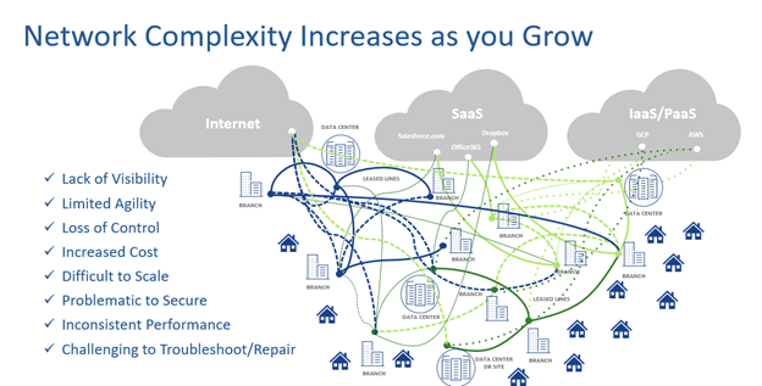
Greater commercial dependence on network operations has raised the bar on service levels. Any type of network outage or loss of throughput can result in a significant hit to the business. Service Providers understand these challenges as a single outage will likely affect multiple customers, magnifying the loss of revenue. For enterprises with revenue models that depend solely on the data centers’ ability to deliver IT and networking services to customers or partners – downtime can be particularly costly. The cost of a 90 minute event could exceed $1 million — that’s $11,000 each minute.
The growth of the cloud, improvements in wireless throughput, and advances in device miniaturization have driven the expansion of mobile computing. This too has added whole new levels of network complexity as large segments of employees, consumers, and businesses have unplugged their desktops in favor of mobile devices. According to Gartner, in 2021 global smartphone sales to end users totaled 328.8 million in the second quarter, an increase of 10.8% year over year. Overall global mobile phone sales grew 10.2% despite supply constraints due to COVID-19 related production disruption and component shortages.
Statista measured over 33 billion internet connected devices in February 2025. About a third of those devices are desktops, laptops, and mobile phones. The vast majority of the rest are IoT devices. According to Vint Cerf, co-inventor of the Internet Protocol, between 80% and 85% of internet traffic is now video. And Telefónica, the global network, measured 5.5 billion internet users in 2025. That’s almost 70 percent of the world’s population.
Number of Connected Devices Worldwide as of February 2025, by Device
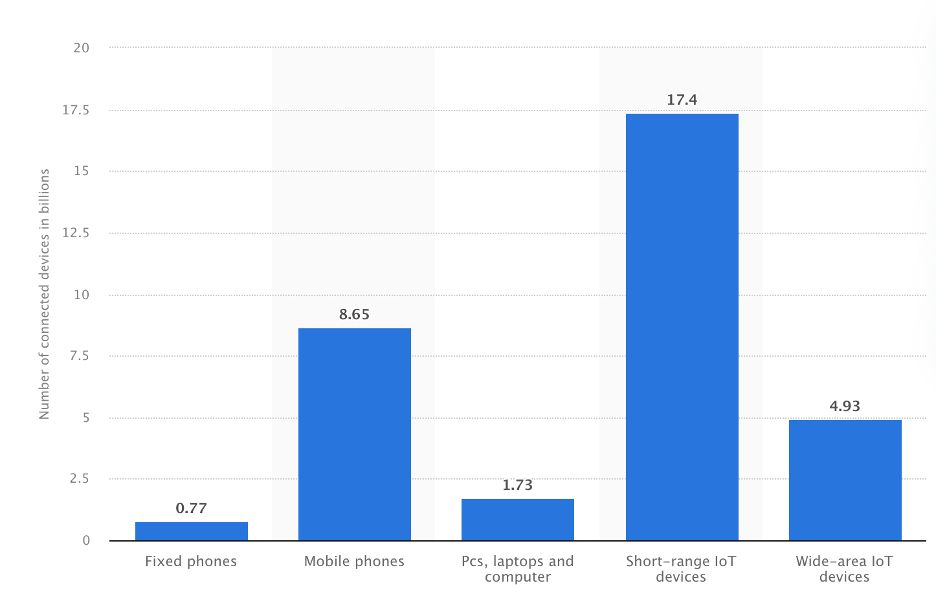
Source: https://www.statista.com/statistics/1559435/connected-devices-worldwide/
Increased traffic and device proliferation accelerated the depletion of IPv4 address space. For more than a decade, the transfer market has been the only reliable source of IPv4 addresses. Brokers like IPv4.Global have transferred mil-lions of addresses for thousands of clients. But the IPv4 address space is small and fixed in size. IPv6 is the future. IPv6 is spacious and has plenty of room for a growing internet. Nonetheless, its adoption varied dramatically across the world. Some highly developed countries have minimal IPv6 deployment. The exhaustion of IPv4 addresses continues to drive the adoption of IPv6, along with the implementation of dual-stack environments to support this new global reality. This uneven transition will only further complicate matters for enterprises on a global level, as they will have to support both protocols for the foreseeable future.
Uneven IPv6 Deployment
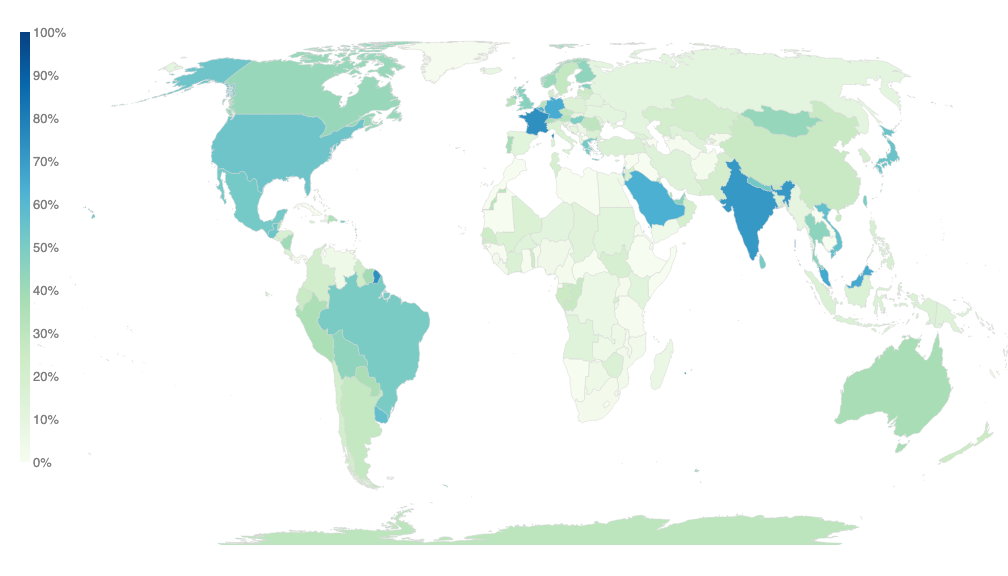
Source: Internet Society, https://pulse.internetsociety.org/en/technologies/
To stay competitive, enterprises must adopt provisioning solutions that can understand the entire network, regardless of device, location and cloud. These solutions must also provide value to the current legacy infrastructure and allow vendor agnostic access to new technologies like SDN/NFV without disrupting operational workflows.
Provisioning Challenges Facing Enterprises
These global trends are presenting enterprises with three major challenges: ensuring service quality, profitably adding new revenue-generating mobile and managed services, and preparing for globally emerging technologies like IPv6 and DNSSEC.
Ensuring Service Quality Even as the demands on network performance and reliability have soared, IP network management processes have fallen behind, and network managers at most enterprises today are swamped with change requests. The result of these fractured groups and processes is what we term the “dumb silo” – local one-off tools that don’t scale and only solve a limited problem but then have no ability to understand context for provisioning.
Homegrown scripts and manual spreadsheet-based processes used at many enterprises are no longer sufficient for tracking configuration changes and provisioning new services with various metadata components. With the swelling influx of change orders, device adds, new service requests, legal requirements, and accompanying address changes, operators are increasingly challenged to keep up. In addition, the environment itself is becoming complex and brittle. Years of accumulated protocol overlays, competing standards, proprietary equipment, rotating personnel, undocumented code and ephemeral workloads have created a rigid, unwieldy infrastructure that is increasingly error-prone and difficult to manage. Introducing new technology initiatives like NFV/SDWAN or even virtualization and container-based technologies in such an outdated environment is a recipe for disaster for the most robust operational team.
Inevitably, enterprises are facing delayed service deployments, higher operator error rates, and the ever-present threat of a significant network outage. But under the current management and control model, these issues are impossible to prevent, because operating procedures are too compartmentalized, legacy and manual processes are too inefficient, and the cost of adding additional personnel is simply too great. For most enterprises, the “dumb silo” has mutated from an occasional hiccup to a problem and can’t be ignored.
Profitably Introducing New Services To retain customers, maximize revenue from legacy network assets and offset declining transit costs, enterprises must roll out new, value-added services, software as a service (SaaS), infrastructure as a service, and managed networks. However, given the complexity of provider networks and the inefficiencies of their siloed services involve numerous underlying systems, a spreadsheet-based or isolated provisioning process turns deployment into a lengthy ordeal that delays rollouts, increases errors, and undercuts profitability, particularly when operations personnel are not familiar with each step in the procedure. Due to the lack of a holistic approach to infrastructure provisioning, introducing new enterprise services across a variety of provider platforms carries an even bigger risk as time passes with legacy manual processes behind the scenes. management processes, these services are difficult and costly to deploy.
Preparing for globally emerging technologies like IPv6 and DNSSEC. There is no getting around it: The transition from IPv4 to IPv6 is a major undertaking that affects every facet of an enterprise’s business from capital expenditure to customer service.
A growing percentage of customers are already making use of IPv6. In 2025, worldwide IPv6 deployment has reached 50 percent, with deployment in the US at 55 percent. In France, Google measures under a sixth of internet traffic using IPv4. In the US, the mobile and cable networks are a large part of IPv6’s growth. T-mobile, Verizon, Comcast, Spectrum, and others have led IPv6 deployment, which simplifies their networks. They have been supported by app stores, with Apple demanding IPv6 support from apps for almost 10 years.
IPv6 Adoption
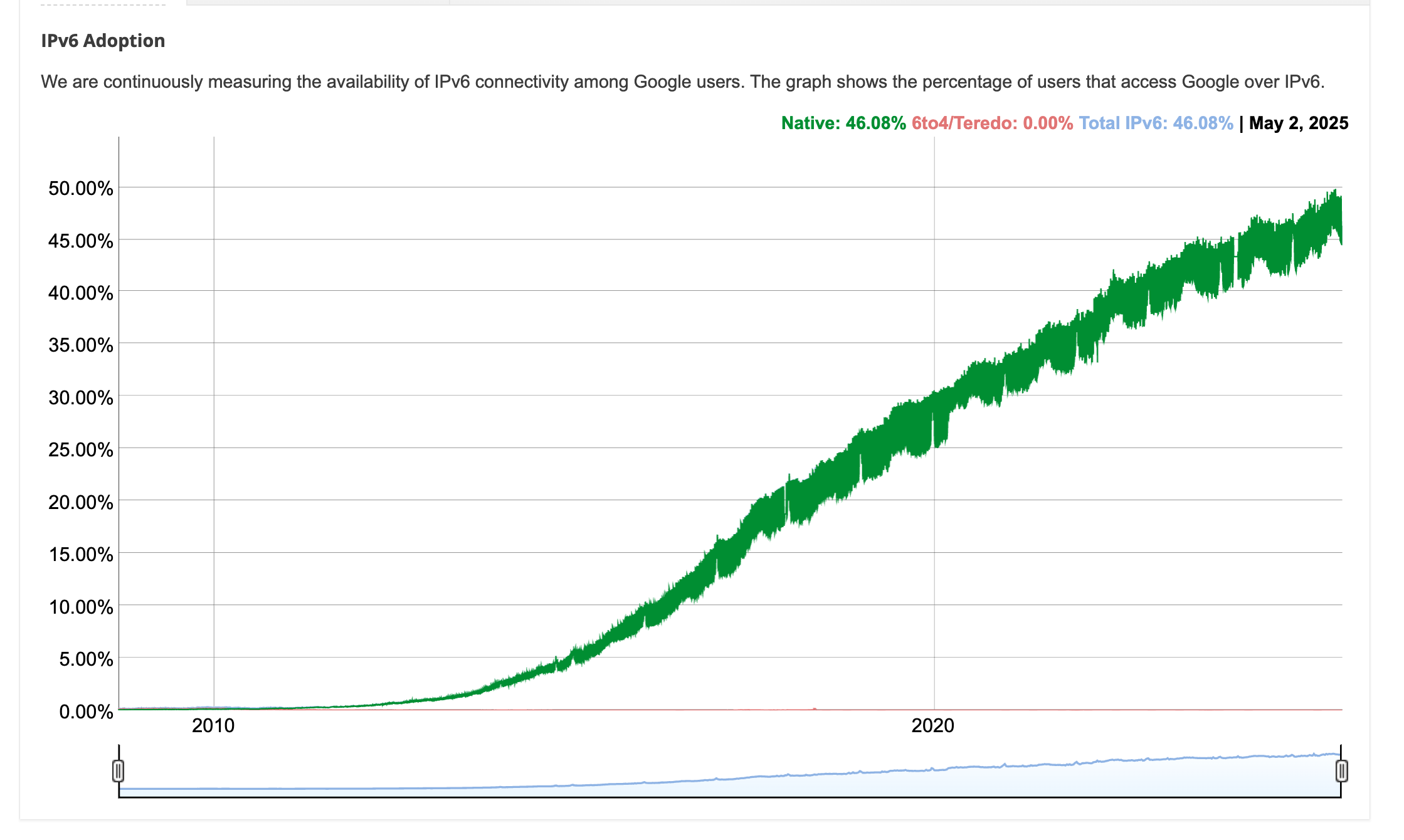
Global IPv6 traffic measured by Google: https://www.google.com/intl/en/ipv6/statistics.html#tab=ipv6-adoption
To accommodate this growth, enterprises must ensure that their networks are dual stacked (i.e. support IPv6 and IPv4 protocols). This will require new platforms and software supported by updated operating procedures. And because there will be a prolonged period when the only new routable addresses will be available under IPv6 but most Web-based content will still only be available via IPv4, enterprises will be forced to run both versions of the IP protocol concurrently. However, older network infrastructures may not allow for dual stacking and will have to rely on some form of encapsulation technology, such as tunneling or gateways, in order to support the dual protocols. This effectively means that technical operations teams will be responsible for two operational networks, resulting in a massive burden on the organization to simply level the same services to their end users.
Another critical issue to note: Under IPv4, with its relatively small number of public addresses, RFC 1918 space and network address translation (NAT) was implemented to allow devices to “share” an IP address. This changes radically with IPv6, which, with its vastly larger pool of available addresses and greater importance on IP allocation methods. This shift toward access control lists (ACLs) is key for firewall configurations, router management and prefix lists to ensure that devices are reachable or hidden per a given security policy. In other words, introducing IPv6 means that managing IP address assignments and related services will become far more complex than it is today.
Automated Provisioning: The Solution for Growing Network Complexity
Many network administrators are turning to automated provisioning software designed to help eliminate network management and automation complexity.
Manual, spreadsheet-based provisioning focused on individual, vendor-specific network elements cannot keep up with the proliferation of new devices and the dynamic nature of today’s networks. As a result, manual configuration raises the risk of network outages and delays the introduction of new services while forfeiting revenue and customer trust in the process.
An automated provisioning and control platform in contrast, integrates the entire infrastructure provisioning process, including IP address assignment, DHCP, and DNS configuration and with the ability to tie in permissions and object metadata using vendor agnostic methods. Each step in the process is carried out automatically, in a dynamic fashion, as new services are deployed and devices are attached or detached from the network. Policies can be defined and put in place to set parameters for how the system carries out these tasks. The platform consists of a suite of software tools that enable enterprises to:
- Significantly reduce operational costs by automating labor-intensive tasks such as IP address allocation, DNS zone management, DNSSEC zone signing, and DHCP configuration for both physical and virtual network elements
- Improve service consistency and reliability by reducing error rates and integrating related tasks into repeatable processes
- Improve operator productivity and accelerate new service delivery by replacing functional silos with integrated workflows, and by replacing slow manual processes with dramatically faster API-led automated responses
The various tools of the provisioning suite refactor the individual tasks involved in allocating IP address space and configuring different devices into a workflow of repeatable processes. This integrated workflow reflects the reality in which the network is actually managed, and the different software functions all feature a similar look and feel and can all be accessed from a single screen. This allows network architects to have a different view than network operators or DNS administrators, with each interface designed to prioritize the tasks that each user needs. This approach also allows for more in-depth workflow optimizations that reflect the specific use cases as needed versus having to modify and retrain operators for simple changes.
Optimally, the tool suite also includes asset identification and management features. These include asset identification and inventory, hardware assignment, and configuration capabilities that make it possible to track and view all the IP-enabled devices attached to your network in real time. This is particularly critical in light of the transition to IPv6 because all devices with an IP address will be visible on the network and need to be accounted for and secured. These devices can have multiple IP addresses and DNS data associated with them, so having an asset system that can understand the metadata and associated context for objects is crucial.
Any provisioning platform should be acquired with an eye toward “future-proofing” the network and the related infrastructure provisioning workflows. This means:
- The provisioning platform GUI must be built natively on its own web service REST API.
- The software should run on non-proprietary operating systems and database architectures.
- Most critically, IPv6 and DNSSEC support should be integral to the software and not simply provided as a “bolt on” or a static field. This includes support for auto-subnetting and integration of policy administration into the management interface. The software should provide tools to define, log, and track policies as defined by the administration for a distributed operations team.
- The Regional Internet Registries (RIRs) should be fully integrated because they are a key component of provisioning that normally involves yet another manual process that delays provisioning, and they provide a simple interface with the upstream regulatory bodies – including support for geolocation data feed outputs.
Benefits of Network Automation Software
An automated infrastructure provisioning system offers enterprises numerous benefits including:
- Faster: a dramatic reduction in the time operations personnel and network administrators must spend provisioning network infrastructure for IP-based devices and services
- Accuracy: the near elimination of address assignment and device configuration errors during the provisioning process
- Policy: centralized network infrastructure provisioning for consistent workflows across multiple departments and functional groups
- Simple: full integration of IPv4/IPv6 with DHCP and DNS allows administrators to dynamically allocate and assign IP addresses by defining, deploying, and managing IP ranges and metadata – from the aggregate to the host level
- Visual: integrated automation of entire address allocation and configuration process via GUI or API
- Auditable: global audit trail for all provisioning changes, providing full visibility into who changed what and when with real-time exporting to third party logging systems
- Live: discovery, tracking and auditing of all network-attached, IP-enabled devices via existing distributed network-monitoring tools and ProVision Connectors – even in dual stack environments
- Flexible: API-first agnostic provisioning layer provides flexibility, migration paths and reduced vendor lock-in
- Accuracy: increased provisioning data accuracy, including support for RIR/LIR (Regional Internet Registry/Local Internet Registry) objects and updates
- Optimization: network optimization based on a complete view of the network and policy-based network configuration
- Faster: accelerated service deployments and faster time to market for new, value-added service offerings as a result of greater staff productivity and streamlined provisioning
- Efficient: more profitable growth based on a lower cost structure, less revenue loss due to service interruptions, and the rapid introduction of new, high-margin services
What to Look for in an Automated Provisioning
These are several important attributes to consider when evaluating the automated provisioning platforms available today:
Flexible automation and orchestration: Seek a solution that provides a flexible, adaptable Application Programming Interface (API) that can conform to the enterprise’s provisioning requirements and processes. This ensures a more rapid deployment and avoids a “force fit” situation in which people and processes must adapt to the new tools. Metadata continues to increase in importance with network infrastructure and is crucial to scalable network automation – especially with distributed environments and multiple vendors.
Vendor-agnostic software: Look for a vendor-agnostic solution that allows current systems to remain in place “as is.” This helps keep deployment costs low by minimizing the need to invest in new systems and allows enterprises to deploy best-of-breed systems going forward without fear of vendor “lock-in.” If a Connector-based strategy is used, that implies that the software is able to easily expand functionality and grow with you.
Comprehensive support for IPv6 and DNSSEC: Choose a solution that provides more than simple address tracking. Look for functions such as auto-subnetting, which simplifies configuration issues and eliminates common problems such as double assigning the same IP address, and address block tracking, which can replace ad hoc address assignments based on immediate operational requirements with address allocation policies based on service and customer priorities. Make sure these IP data sets are tied to DNS and DHCP systems for the most accurate provisioning workflows.
Support for non-proprietary operating systems and environments: Select software that runs on non-proprietary operating systems such as Linux and is compatible with other deployment models like containers or virtual machines. Other open standards should be supported too, including open APIs such as REST. This ensures that the provisioning suite can support the broadest possible array of devices and network configurations now and in the future.
Rapid provisioning: Only consider automated provisioning systems that reduce the time needed for common tasks, such as assigning a block of IP addresses, by a minimum of 80 percent. This will maximize your productivity gains. This should be accomplished by using APIs, so ensure that rapid provisioning actually functions with production conditions – not just in a lab with a minimal data set.
SaaS and local service options: Choose provisioning vendors whose software can be deployed as either a hosted, SaaS-based service, or locally, behind your own firewall, and make sure the software can be deployed in a matter of minutes, not months. This gives you maximum latitude, thus allowing you to choose the model that best supports your own financial and operational requirements. Some vendors may also offer hybrid models that may permit a local environment with offsite synchronization to a cloud platform. This can be a useful element of a backup and data recovery strategy.
Data analyst support: Seek out a provisioning vendor that includes access to a team of data analysts in your service package. These experts can provide quick, efficient support for common implementation problems such as identifying redundant address assignments, normalizing data sets and other issues which can greatly expedite your roll out. Another side effect of this skill set is the ability to extract important metadata from existing fields in legacy systems to prepare for automated tasks.
Usage-based purchase terms: Choose a provisioning vendor that allows you to buy the software based on usage and adjust the terms up or down as requirements change. This means you won’t be forced to purchase more capacity than you actually require and aren’t trapped by legacy “per IP” charge models. This approach to pricing should also reflect the arbitrary role of RFC 1918 space (and not factor into pricing) while understanding IPv6 and it’s role alongside IPv4 in many environments.
ProVision: Best in Class
ProVision, our automated network provisioning software, embodies all the features and functions described above. The software dynamically and holistically provisions all the network control factors required to initiate and operate network and data center elements, including IP addresses, DNS zones, DNSSEC implementation, and DHCP pools, by taking into account VLAN and device-level information. Available as either a highly scalable cloud or an on-premise solution, ProVision automatically controls these factors across distributed or separate physical and virtual networks through its intuitive GUI or robust REST API.
Built from the ground up to support the transition from IPv4 to IPv6, including dual-stack implementations, the ProVision toolset includes:
- REST API simplifies integration with the widest possible range of applications. Extensive documentation and numerous code samples are available with the API being used natively within the ProVision application.
- Multi-Tenant Capabilities are built-in to ProVision for delegating administration to downstream customers or internal functional groups – either via customized ProVision GUI or your own service portal.
- Connectors provide on-demand expandability to accommodate both legacy provisioning environments and the latest SDN/NFV technologies. ProVision can communicate with objects via SSH, API and everything in between.
- Context-Aware Resource Management can store information on all physical and virtual network assets in real time. The module builds hierarchies tied to provisioning data using an unlimited number of custom fields for classifying an unlimited number of asset types.
- IP Address Management, which includes complete IPv4 and IPv6 support for everything from subnet management to hosts. The IPAM tool manages both internal and external address assignments and reduces the time required to provision a block of IP addresses from 45 minutes to an astonishing 15 seconds, a time savings of 99.4%. ProVision also supports RIR/LIR integration features depending on scale of the network and business model.
- DNS Controller that supports multiple DNS servers using different DNS technologies. ProVision integrates with a variety of DNS servers and services with built-in import tools to ease migrations and zone/record file management.
- DHCP Controller, including DHCPv6 support, maintains uptime without sacrificing performance or security. The module supports even advanced DHCP server options by using the intelligence of your existing DHCP infrastructure and providing you a single management GUI for control or via REST API.
- Peering Manager uses a combination of workflow automation and Connectors to provide one-click BGP session configuration across multiple exchanges. ProVision integrates with PeeringDB to pull in exchange and contact information to streamline the Peering Coordinator workflow.