


Executive Summary
LTE, Machine-to-Machine communications, and IPv6 enabled device growth are converging to increase the operational requirements of wireless service provider networks. Together, these changes demand the rapid replacement of legacy, manual and/or isolated network provisioning processes by automated, virtual provisioning platforms that can more reliably, dynamically and quickly discover, configure and control the network resources needed by today’s IP based wireless communications.
These network resources are typically combinations of physical and virtual elements such as IP addresses, VLANs, DNS zones, DNSSEC keys, DHCP scopes, and tracking other device related data sets for integration into other platforms, billing systems or monitoring environments. This paper examines these trends and highlights how ProVision’s Dynamic Network Provisioning platform efficiently and effectively performs these important network operations functions at a much lower operational cost than traditional hardware or legacy homegrown solutions.
ProVision Overview
Provisioning and configuring networks are intrinsically manually intensive processes focused on individual, vendor-specific, network elements rather than the holistic provisioning of mobile network assets across distributed networks and virtual environments. These manual configurations cannot keep up with rapidly changing devices and networks, creating outage risks for network and data center that forfeit revenue, customer trust, and delay the introduction of new services. In addition, manual network provisioning limit the ability to holistically enforce compliance, concurrently update network policies and protocols, or manage or rollback network configurations because they are often done in isolation rather than across systems and only address vendor specific hardware or software elements rather than entire networks. As a result, networks cannot be provisioned and controlled at the pace required by our virtual and mobile business operations.
ProVision, our unique Dynamic Provisioning control platform, overcomes the problems created by decoupling network control from network vendor hardware or software. This platform dynamically and holistically provisions all the network control factors needed to initiate and operate network and data center elements, including IP addresses, DNS zones, DNSSEC signatures, DHCP pools, VLAN and device level information – all built on a multi-tenant web service REST API. Available as either a highly scalable cloud or on-premise solution, ProVision automatically controls these factors across distributed and separate physical networks in order to reduce errors that can crash networks, cause compliance errors, and delay the creation of new services.
In addition, 6connect’s ProVision platform uses advanced technology Connectors along with a newly launched KOALAPI(™) for controlling and interacting with external software, software and services to integrate their data into a centralized provisioning environment. Beta versions of this product are being tested for feedback by a handful of select service providers and enterprises for more advanced discovery/control feature development. These advanced features enable network managers to understand and resolve the important operational challenges posed by the growing number of utilized IP addresses, network mobile devices, and monitoring of virtual devices across their global networks.
Envisioned Benefits
ProVision’s IP and network resource provisioning platform fits perfectly with the emerging trend of IP networks. Built by service providers for service providers, 6connect’s ProVision Dynamic Network Provisioning platform enables significant time savings and operational benefits that would matter to service providers, including the following:
- Automated and accurate provisioning of IPv4 and IPv6 resources across the service provider’s entire network, that accelerates the creation of new services by 80%
- Systematic, multi-service provisioning of DNS and DNNSSEC credentials for all network devices and services
- Connector based framework for simple integration into current monitoring systems for centralized automated discovery of physical and virtual devices deployed across the network,
- API based infrastructure provisioning for easy integration of legacy systems where appropriate and reduced operational disruptions while adopting new technologies like cloud/SDN/NFV and container-based solutions.
As this paper explains, these benefits are especially relevant to a service provider’s deployment of LTE services across its all IP transport network.
Drivers for Change
Market Changes Drive the Adoption of IP Core Services
4G advanced LTE services, Machine-to-Machine (M2M) communications, and “Bring Your Own Device” (BYOD) adoption are creating unprecedented growth opportunities and operating challenges for service providers globally. As of July 22, 2015, the Global Mobile Suppliers Association (GSA) reports that 422 commercial LTE networks have been launched in 143 countries . GSA also reports that, as of June 21, 2015, 3,253 total LTE unique user devices have been launched globally , and that 635 million subscribers were actively using LTE in March 2015 . Ever-increasing use of smartphones, tablets, and M2M connected devices within the “Internet of Things” (IoT) will escalate network access and backhaul demands on today’s wireless networks, requiring the rapid transformation of wireless network architectures, radio access networks, and the core packet network and operational processes supporting them.
Signs of the need for rapid network change are appearing globally. Dell’Oro Research predicts that the total LTE market (macro and small cell) is expected to double between 2013 and 2019, and the total Small Cell market (including distributed radio systems) is expected to grow more than ten-fold between 2014 and 2019. This growth will add additional complexity to network provisioning and operations because much of it will occur in indoor sites, not in traditional outdoor coverage sites, to boost cell site performance.
These changes accelerate the transformation of a service provider’s wireless network data and communications amongst all of its radio access networks, from a mixed-circuit and IP core to an entire IP core network. By replacing circuit data, an IP Core network enables the establishment of data intensive and application-central business models that create new revenue streams. IP core networks also create significant cost savings by replacing circuit switched voice with lower cost voice-overIP (VoIP) traffic. This has triggered the growing adoption of Evolved Packet Cores (EPC): new, high-performance, high-capacity all-IP core networks that separate the control and data planes and, through a flattened IP Cloud architecture,reduce the hierarchy between mobile data elements.
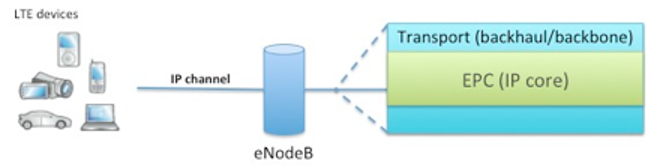
Figure 1. LTE deployment with EPC Over Conventional Transport
The consolidated network provides additional carrier revenue opportunities along with reduced management costs compared to traditional technologies. However, provisioning and managing these elements across distributed and heterogeneous network architecture is a daunting task. With the addition of IP technologies like IPv6 and more connected “smart devices” leveraging the IoT infrastructure, device tracking, management, and auditing will continue to become even more of a challenge than they are today.
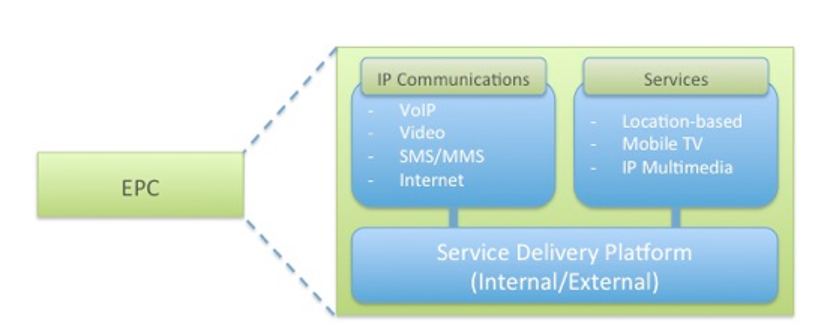
Figure 2 Detail of EPC Unified View
The flattening of service provider networks in LTE implementations has profound implications:
- Mobile services are all built on the IP protocol.
- Joining of new mobile architectures with previous mobile technologies (2G/3G) and core legacy network infrastructure.
- Scalability required for increases in users, bandwidth, and user/device mobility.
- Service reliability and availability for uninterrupted service.
Another reason for service providers automating their network provisioning process is the rapid growth of dual stack and IPv6-enabled devices, which is especially acute in the LTE mobile market due to LTE’s use of IPv6 addressing for endpoints.
IPv6 mobile deployments will grow significantly according to Cisco’s Visual Networking Index May 2015 update.[1] In 2014, 2 billion mobile devices shipped were Ipv6 capable, with an expected CAGR of 25% by 2019 (projected 6.2 billion).. These devices include all Internet-connected mobile devices such as M2M end-points, smartphones, and tablets. In 2014, IPv6 traffic grew 227 percent, and Cisco predicts IPv6 traffic will grow 17-fold by 2019.
IPv6 changes will also occur simultaneously on wire-line networks as well. Twenty-two percent of all fixed and mobile-networked devices were IPv6 capable at the end of 2014.[2] Cisco forecasts this to grow to 41% by 2019, creating additional provisioning and network control strains on networks on a global scale.
To accommodate these trends, service providers will need to ensure that their radio access networks and EPC are both IPv6-enabled. This will mean new equipment and software supported by new operating procedures. And since there will be a prolonged period where only new routable addresses will be available under IPv6, but most Web-based content will still only be available via IPv4, service providers will be forced to support both protocols concurrently via dual stacking, running both versions of the IP protocol in parallel. However, older network infrastructures may not allow for dual stacking and will have to rely on some form of encapsulation technology, such as tunneling, in order to support both protocols.
Evolved Packet Core Provisioning Requirements
EPC’s provisioning and control requirements surpass the capabilities of legacy and internally developed network provisioning solutions typically used by service providers. Most legacy solutions were Command Line Interface (CLI) centric and focused on provisioning networks in isolated silos rather than dynamically provisioning, monitoring, and controlling the network from end to end. This fundamental mismatch between legacy network operations and provisioning approaches and the new common service delivery platform and IP services that are intrinsic to the EPC’s strategic value must be resolved for Service providers to achieve an acceptable ROI on their LTE investments. This becomes even more exacerbated if the legacy network infrastructure is being tasked to support new cloud technologies or SDN/NFV platforms.
However, many Service providers still extensively rely on legacy, manual procedures or hardware intensive solutions to provision their networks, slowing down their responsiveness to customer needs, network demand changes, and leading to inaccurate provisioning that can create resource conflicts between network resources and even outages. The shortcomings of these approaches are summarized in Figure 3 below.
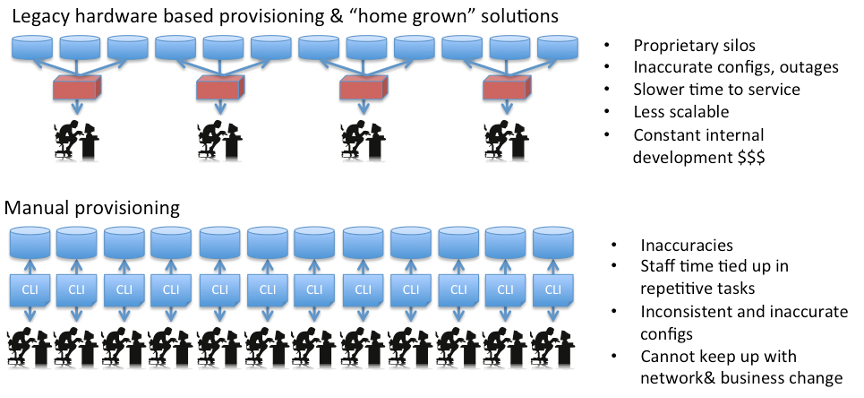
Figure 3 Shift from manual processes to information silos
- Lightweight, dynamic footprint that gets the provisioning and control job done without requiring extensive deployments of new, costly hardware across the core and edge networks
- The automated ability to rapidly configure both IPv4 and IPv6 network resources such as IP addresses, DNS zones, and DNSSEC keys for physical and virtual network devices across the core and edge radio access network
- Logical, integrated views of and provisioning of network resources allocated to customer service maps across multiple network domains and topologies
- A single management platform that provides instantaneous, integrated views of network resources across the edge and core networks; and applies privilege based user rights to provisioning and changing these resources per the design of the overall network architecture management team
- RESTful API connections to existing and new hardware management systems, order entry systems, third party applications that support new revenue generating services, and sales force automation systems to leverage existing reporting and management capabilities and streamline end to end processing of change requests
The solution is a decoupled, vendor agnostic control plane or “Provisioning API Layer” that automates network device configuration and control on a network wide scale, and also utilizes a web service built on a RESTful API structure for easy integration with existing systems and third party web services, as depicted in Figure 4.
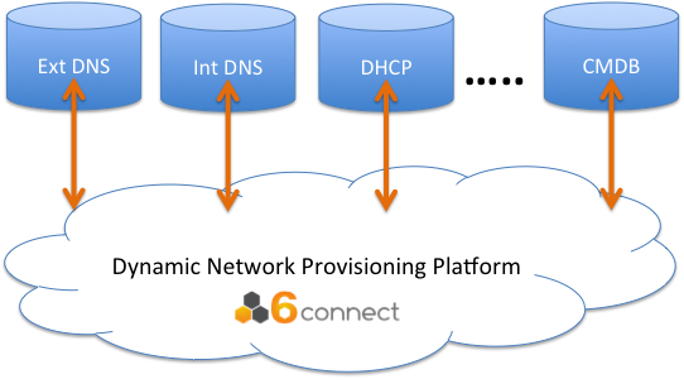
Figure 4 Decoupled network control plane to minimize vendor dependencies
Solution Overview
ProVision, 6connect‘s unique Dynamic Network Provisioning (DNP) control platform, overcomes legacy provisioning’s ineffectiveness created by decoupling network control from network vendor hardware or software. This platform dynamically and holistically provisions all the network control factors needed to initiate and operate network and data center elements, including IP addresses, DNS zones, DNSSEC keys, DHCP pools, VLAN and other device level information. Available as either a highly scalable cloud or on-premise solution, ProVision automatically controls these factors across distributed and separate physical networks in order to reduce errors that can crash networks, cause compliance errors, and delay the creation of new services. DNP delivers significant value and benefits in network function virtualization(NFV), device configuration, and interoperability across heterogeneous network technologies.
Key highlights and capabilities delivered by DNP include the following:
- 80 – 90% time savings on most network resource provisioning tasks
- Secure, open RESTful APIs for easy integration with other systems
- Customizable internal data analytics, with native MySQL support
- Carrier-grade scalability to accommodate billions of devices, hierarchies and end users.
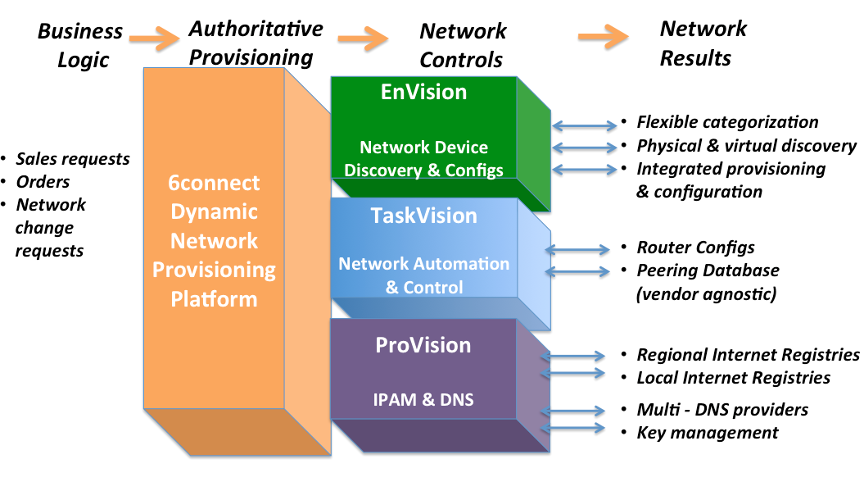
Figure 5 6connect Dynamic Network Provisioning Platform
ProVision consists of four primary functional areas:
- Dynamic Resource Provisioning(™) – The foundation of ProVision that combines a scalable object oriented database structure with robust permissions. The architecture supports enhanced metadata and extensive customization.
- Connectors – Provide a myriad of pre-packaged ways to generate provisioning data and write those changes to external systems. KOALAPI(™) provides more customized integration by allowing you to build and call your own API endpoints inside of 6connect ProVision(™).
- Orchestration – Use existing workflows or modules within ProVision for additional functionality. This allows for various Connectors to be tied to common provisioning tasks. Customization is available for provider-specific workflows.
- Automation – Schedule orchestration tasks within ProVision using your Connected services. With a vendor agnostic provisioning platform that is API driven, this can be done via GUI or REST API calls by outside systems.
The general attributes of ProVision and the benefits are described in the next section. Deployment of ProVision is flexible and can be provided as a hosted solution in one of our international data centers, or installed on dedicated hardware/virtual environments behind the firewall. Since the application is based on standard LAMP technologies (Linux, Apache, MySQL, PHP), there are plenty of options for deployment, redundancy and high availability depending on your requirements.
This section highlights the envisioned use cases for applying DNP to provisioning network resources across an Evolved Core Platform.
For a typical service provider, a sample use case would look like Figure 6 below.
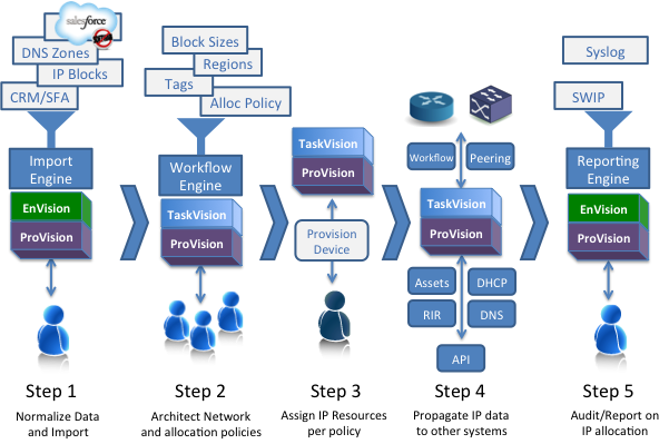
Figure 6 Detail of ProVision dynamic provisioning process
In this use case, a service provider is most likely dealing with staff of varying skill levels and potentially multiple internal systems or information silos. 6connect’s ProVision platform enables the service provider to have a single interface for managing the information, even if the device elements are scattered around a global network and being managed by various personnel (or even customers). This also means that provisioning related data can actually be kept in sync, even across disparate infrastructure technologies.
With DNP, 6connect can automate the sync process, provisioning tasks and subsequent reporting. The application architecture is built on PHP classes tied into a RESTful API. This means that the multi-tenant capable web application is built on the same API that is available for integration. This provides multiple deployment options in even the most complex distributed environments.
Scenario 1 – LTE roll out (IP core)
When deploying an LTE environment with an EPC network, there a multitude of provisioning tasks that are still performed manually. With the rapid rollout of LTE services, providing a network infrastructure that is stable and compatible are key to ensuring a long-term revenue streams for users and related services.
A legacy provisioning approach could take the following steps assuming a centralized information repository exists:
- Configure EPC deployment network architecture (typically in a spreadsheet or static document)
- Train operations personnel on architecture policy for allocating v4 or v6 IP space, creating DNS zones/zone records, etc.
- Subnet out space for allocations manually and add IP information to repository
- Assign hostname/IP information per device and document in repository
- Manually build out related DHCP configuration files
- Manually build out related DNS infrastructure and zones including any DNSSEC zone signing and key generation/uploading
- Repeat as needed for additional device assignments
- Repeat as needed per cell deployment
- Audit IP utilization by reviewing spreadsheets for increased IPv4 allocation efficiency
With legacy approaches, these tasks could take hours or days. By contrast, 6connect’s DNP can accomplish the same functions in minutes with increased data validation since 6connect does all the subnetting internally along with RFC validation for DNS zone records and DNS templates for prepopulating data wherever possible. Current customers have reported that DNP reduced their provisioning time of network resources by 80 percent because of our Dynamic Resource Provisioning(™) automation.
Maintaining architectural consistency across network deployments is critical to effective and consistent operations. 6connect takes this requirement seriously and has designed architectural service maps into all of its provisioning platforms, which guide the daily-automated provisioning tasks that users can control. Below, in Figures 7 and 8, you can see a sample “network architecture” screen where even the most complex network is built out using regions, tags, and other pieces of metadata (all customizable). This layout powers key features like Smart Assign, Smart Browser and Templates, which allows for service providers to ensure that various network management policies are embedded in the application, and transformed into easily automatable steps. 6connect has even automated the WHOIS update process with Regional Internet Registries (RIRs) that normally used to take hours and multiple emails/portal logins to complete what takes us one-click.
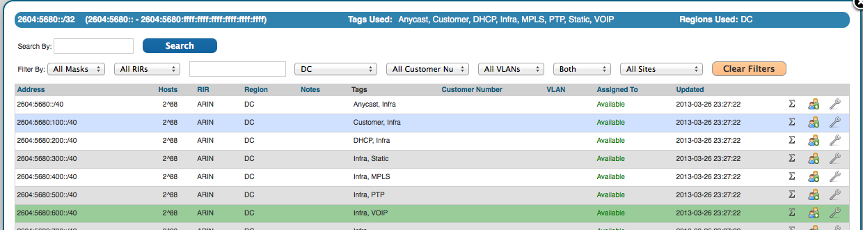
Figure 7 Example IPv6 allocation schema build out
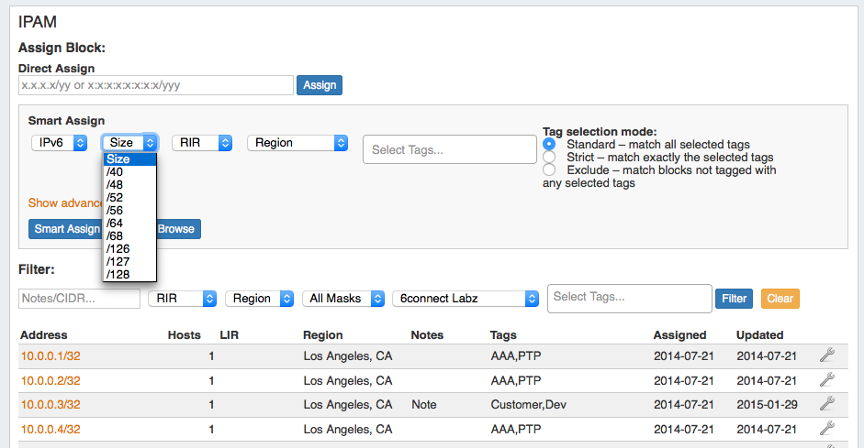
Figure 8 Sample Asset IPv6 allocation process
Scenario 2 – Service Delivery Platform (internal/external groups)
Service models for internal and external customers require a Service Delivery Platform that functions as a flexible web service layer. 6connect’s ProVision platform provides this functionality out of the box for the operational provisioning team as well as external groups and customers. Ideally the solution in this area provides both a RESTful API for integration with other systems along with portal functionality to support more advanced permission based features typically requested by network users and administrators.
This allows flexible deployment of other infrastructure services to further increase reliability (DNS, DNSSEC), future proofing (IPv6), provisioning (DHCP configuration and IP device management), and control (network infrastructure management and automation).
As an example, See Figure 9 for a brief outline of the Smart Assign automated function for assigning IP space based on parameters requested. Note that the function is available in its entirety, versus requiring the developer to do additional customization to automate the task.
Below, Figure 9 provides a GUI perspective on the same Smart Assign feature. In this screen, you can see multiple assignments to a particular resource holder. These allocation requests can be of various sizes in addition to tag/region capabilities. Note that it is designed to work consistently whether completed via the API or GUI with all requests logged and tracked by user/source IP and the workflow is the same whether dealing with IPv4 or IPv6 resources.
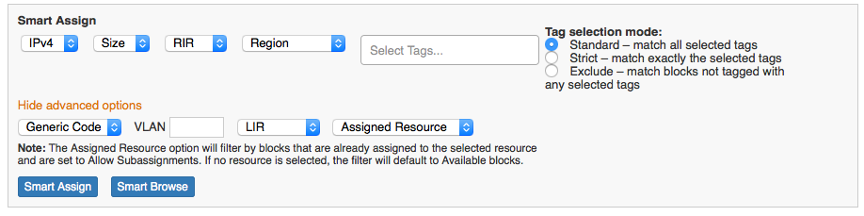
Figure 9 Smart Assign detail view (GUI)
For more information on the capabilities of 6connect’s RESTful API, please reference the documentation link below for the PHP SDK, code samples and additional configuration information.
Scenario 3 – ongoing tower asset audit/tracking
Part of any network build also includes management “post deployment”. This may include specific tools to audit key portions of the network or a combination of tools depending on the user base and the services expected (including location based services or device tracking for fraud/theft detection). By combining these device level data points with conventional network auditing and management tools, service providers can provide a very granular view to the internal or external customer to address concerns, reduce support costs and prevent incidents.
6connect’s Connectors for Nessus, Observium and nmap allow for flexible integration for both agent-based and agentless deployment scenarios. Since the ProVision Resource Manager can understand the various metadata easily, it can serve as a centralized hub for provisioning data while tying assets to their specific permissions.
Scenario 4 – Deployment of smarter LTE cells
One of the tenets of LTE deployments is a more distributed LTE cell footprint. Two factors, the number of users, and the increased bandwidth requirements these converged networks will require this. Platforms like 6connect’s DNP can provision large and small-scale distributed deployments much more effectively than legacy approaches since the steps are intrinsically repeatable.
6connect has built out support for various router/switch vendors for their BGP session manager, and will leverage this integration as compatibility expands to address network devices in both virtual and physical infrastructure. In the case of the BGP session manager, it is also tied back to peeringdb in addition to providing a turnkey Communications Manager where the Peering Coordinator can manage all outbound communications for potential peers.
Below, Figure 12 shows a display of configured sessions at a given peering exchange along with their state. The sessions were configured in real-time by ProVision without the user having to use a CLI of any kind. These configurations can also be further automated depending on processes and preference.
[1] http://www.gsacom.com/news/gsa_430.php
[2] http://www.gsacom.com/news/gsa_429.php
[3] http://www.gsacom.com/news/gsa_428.php
[4] http://www.prnewswire.com/news-releases/ran-infrastructure-market-to-shrink-by-11-b-between-2015-and-2019-according-to-delloro-group-300113419.html
[5] http://www.cisco.com/web/solutions/sp/vni/vni_forecast_highlights/index.html
[6] http://www.cisco.com/c/en/us/solutions/collateral/service-provider/visual-networking-index-vni/VNI_Hyperconnectivity_WP.html
[7] ProVision API documentation can be found here: http://docs.6connect.com/display/DOC/API+v1
https://www.peeringdb.com/
[8] https://www.peeringdb.com/